Telent · Space & Defence

Telent Space Strategy

Mission-Critical, Mission-Ready Technology for the UK's Next Frontier

Lee Harris · Solutions Architect · 5th August 2026

Explore the Strategy
Vision Statement

To become the UK’s most trusted sovereign technology partner for Defence, Space and Critical National Infrastructure — delivering secure, resilient and integrated digital infrastructure, assured communications and satellite capabilities from Earth to orbit.

01 · National Context

UK Space — National Critical Infrastructure

The UK Strategic Defence Review (SDR) 2025 was clear in substantiating the UK Government’s announcement that space is now a recognised UK Critical National Infrastructure (CNI) sector, and a domain of growing competition that is central to warfighting.

  • Space underpins the UK’s security, prosperity, and daily life.
  • The control of space will be critical in future conflict, enabling command & control, providing warning and intelligence, whilst being able to deliver powerful effects.
  • The war in Ukraine has triggered a strategic shift in UK Defence to treat space as a contested frontline, driving increased investment in sovereignty, resilience, and offensive and defensive space control.

UK Defence is to be more ambitious in delivering the space capabilities necessary to fight and win, with the most transformative investments expected in the first four years of the proposed 2026 Defence Investment Plan (DIP).


RAF Typhoon fast jets on the flight line
Air
Royal Navy carrier strike group at sea
Maritime
British Army armoured column on exercise
Land

Space-based ISR

Developing operational sovereign Intelligence, Surveillance, and Reconnaissance (ISR) capabilities for Defence.

Deep Space Advanced Radar Capability (DARC)

Investment to deliver a global network of ground radars enhancing Space Domain Awareness (SDA) of objects in deep space and geospatial orbit, operated jointly with the USA and Australia; the UK element is currently planned for Pembrokeshire.

Space Control

Developing capabilities to enhance our awareness of space activities and protect our critical national assets in orbit.

IASMDOC

A £40m initial investment to integrate the command and control of air defence and space operations, protecting critical national assets (Land & Space).

SKYNET

A further £50m investment to extend the life of the in-service SKYNET 5 military communications satellites, to be replaced by new satellite communications capabilities, including SKYNET 6A, due in 2027.


02 · UK Space Agency

UKSA — Unlocking Space for Government

The UK Space Agency’s (UKSA) Unlocking Space for Government (USG) is a UK-focused initiative dedicated to enabling public sector organisations to adopt satellite/space-enabled technologies — including dual-use capacity with Defence — to provide Earth Observation (EO), Satellite Communications (SatCom), Positioning, Navigation & Timing (PNT), as well as innovative space-derived technologies to improve delivery, efficiency, and resilience of public services.

USG forms part of the broader UK Space and CNI programmes that will deliver on the ambitions of the National Space Strategy, the Defence Space Strategy, and the Space Industrial Plan to increase space applications across public services that support CNI and will position the UK Government as a strategic user of space. Space-based technologies enhance decision-making, reduce costs, and enable more proactive and responsive services across the UK public sector.

Healthcare

Collaborating with NHS Trusts and Integrated Care Boards (ICBs) to explore how satellite connectivity and data can support more efficient and resilient healthcare delivery.

Transport Infrastructure

Partnerships with national and local transport bodies to trial and scale the use of EO data, particularly Interferometric Synthetic Aperture Radar (InSAR), for infrastructure monitoring and resilience planning.

Environmental Monitoring

Supporting the use of remote space-based sensing to tackle environmental risks and build resilience.

In summary, USG supports:

Central & Local Government departments seeking innovative space-related solutions to operational challenges.
Frontline Public Sector Organisations — such as NHS, Transport Agencies and Emergency Services — exploring how satellite data can improve services.
Space Companies aiming to understand public sector needs and routes-to-market.
Policymakers looking to embed space in wider government strategies, such as resilience, net zero, or digital transformation.

[email protected]

03 · The Opportunity

What is UK Space worth?

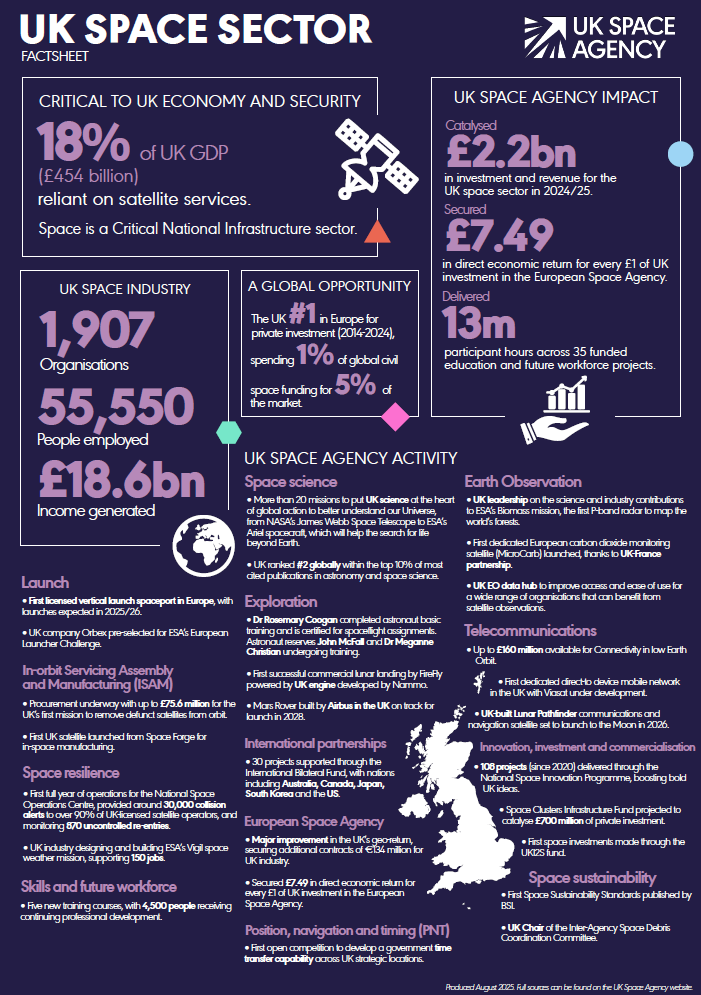
The UK space sector generates a significant return of approximately £17bn–£19bn in annual revenue, employing approximately 55,000 people directly, with a further 81,000 jobs in the space supply chain, generating an annual income of £18.9bn. Approximately 18% of the UK’s GDP critically depends on space/satellite services, with global demand continuing to grow.

0% of UK GDP relies on space/satellite services
£0bn annual income generated across the sector
0k people employed directly (+81k in the supply chain)
European Space Agency badge £0 direct economic return for every £1 invested in ESA

Why this matters commercially

  • Access to large public-sector budgets.
  • Long contract durations (3–15 years).
  • Recurring managed-service revenue.
  • High customer retention.
  • Opportunities to expand from pilot projects into enterprise-wide programmes.

UK defence/space spending trajectory

Union Jack flag over the Houses of Parliament
2024/2025

UK defence spending was approx. £60bn, with UK Government also committing £2.2bn in investment and revenue for the UK space sector.

2027/2028

£74bn allocated to the MoD.

2029/2030

UK Defence spend is expected to be 27% higher in real terms than in 2023/24.

An estimated £298bn in Defence investment is expected over the next four years, with an estimated £3.2bn allocated for space capabilities.

UK Space Sector factsheet, UK Space Agency
Source: UK Space Sector Factsheet, UK Space Agency.
04 · Strategic Rationale

Why Develop Space?

Illustration of a global satellite communications network connecting Earth

Continued growth and expansion of UK Defence into Space

UK MOD recognises that modern military operations depend heavily on space-based capabilities that enable UK Armed Forces to:

  • Communicate globally through military satellite communications systems, e.g. Skynet.
  • Navigate accurately using satellite-based positioning, navigation and timing (PNT) services.
  • Gather intelligence and surveillance data from satellites to monitor threats and support military operations, e.g. ISTARI.
  • Provide command and control for deployed forces anywhere in the world.
  • Detect potential missile threats and monitor activity in space to protect UK and allied interests, e.g. RAF Fylingdales & DARC.

Expanding commercial use: Unlocking Space for Government (USG)

A UK Space Agency initiative focused on enabling public sector organisations that Telent supports across the business to adopt satellite/space-enabled technologies, improving the delivery, efficiency and resilience of public services. It forms part of the broader programmes delivering on the ambitions of the National Space Strategy, the Defence Space Strategy, and the Space Industrial Plan to increase space uptake across public services and position the UK Government as a strategic user of space.

Satellite Communications (SatCom), Positioning, Navigation & Timing (PNT), Earth Observation (EO), and space-based intelligence are now fundamental components of modern UK national infrastructure. As dependence on these services grows, the requirement shifts from simply procuring satellite connectivity to integrating space capabilities into resilient, secure operational environments. UK Defence, emergency services, utilities, transport operators, and government agencies are all becoming increasingly dependent on space-derived services to support:

Command & Control
Situational Awareness
Secure Communications
Infrastructure Monitoring
Operational Continuity

Beyond commercial broadband

Commercial LEO providers such as Starlink and OneWeb offer impressive connectivity, but Defence and National Security customers require more than broadband access — they require:

  • Fixed and controlled addressing
  • Security accreditation
  • Traffic segregation
  • Assured service availability
  • Compliance and policy enforcement
  • End-to-end operational monitoring
  • Integration with existing WAN, SD-WAN and mission networks
05 · Telent Credentials

Why Develop Telent Space?

Telent is a trusted partner and a leading UK technology company specialising in the design, build, support and management of the UK’s critical digital infrastructure. We are therefore very well positioned to develop and evolve our integrated and collaborative capabilities to support the UK CNI in both Space & Defence, with Mission-Critical, Mission-Ready Technology and Services for Smarter Decision-Making and Operational Advantages.

Identified synergies with existing capabilities across Telent are transferable and exploitable, and will enable us to capture and deliver future opportunities in the Space sector — especially where these are deployed within Defence and UK CNI infrastructures. Telent provides advanced Defence Network & IT services and pioneering Defence technology solutions that transform traditional military tasks and operations into connected, intelligent ecosystems.

Telent engineers and field staff at work across transport, healthcare and emergency services sites

Why does all this matter to Telent?

Telent already supports essential operational networks across transport, public safety, emergency services, defence communications and critical national infrastructure. Space represents a natural extension of these environments rather than a completely new market.

Telent’s expertise lies in transforming communications technologies into managed operational capability — positioning Telent to bridge the gap between commercial satellite connectivity and Defence-grade operational services, and to become the UK’s leading and most trusted Sovereign Technology Partner for Defence, Space and Critical National Infrastructure.

Long-Term Opportunity

The long-term opportunity is not to compete with satellite operators; the opportunity is to become the organisation that enables customers to securely operationalise and integrate satellite & space services at scale with resilient infrastructure.

Achievable through Strategic Partnership & Acquisitions.

06 · Future Development

General Growth Requirements

Technology transformation

New technologies and services in the space sector are emerging all the time, along with new threats, risks and hazards — especially as space itself becomes more congested and contested. In response, organisations such as Telent are increasingly adopting new and emerging technologies into solutions across industries that can be adapted and used to alleviate these:

AI & Analytics
Digital Engineering
Cloud Platforms
Secure Collaboration
Zero-Trust Security
Data Modernisation
Autonomous Systems
Edge Computing

Rapidly growing UK space sector

Emerging growth areas within the UK space sector — comprising military, commercial and dual-use capacity, as well as academia utilisation of space-related assets and services — include:

  • Satellite Communications (SatCom)
  • Earth Observation (EO)
  • Space Domain Awareness (SDA) and Space Situational Awareness (SSA)
  • Launch Services & Spaceports
  • Space Sustainability: In-orbit Servicing, Assembly & Manufacturing (ISAM) and Debris Removal
  • Defence & Space Integration (Dual Use)
  • Lunar and Deeper Space Exploration
  • Development of space-related skills and future workforce
07 · Telent Organic Capability Growth (Space)

Space Domain Awareness

Object Demonstration & Orbital Presentation Tool

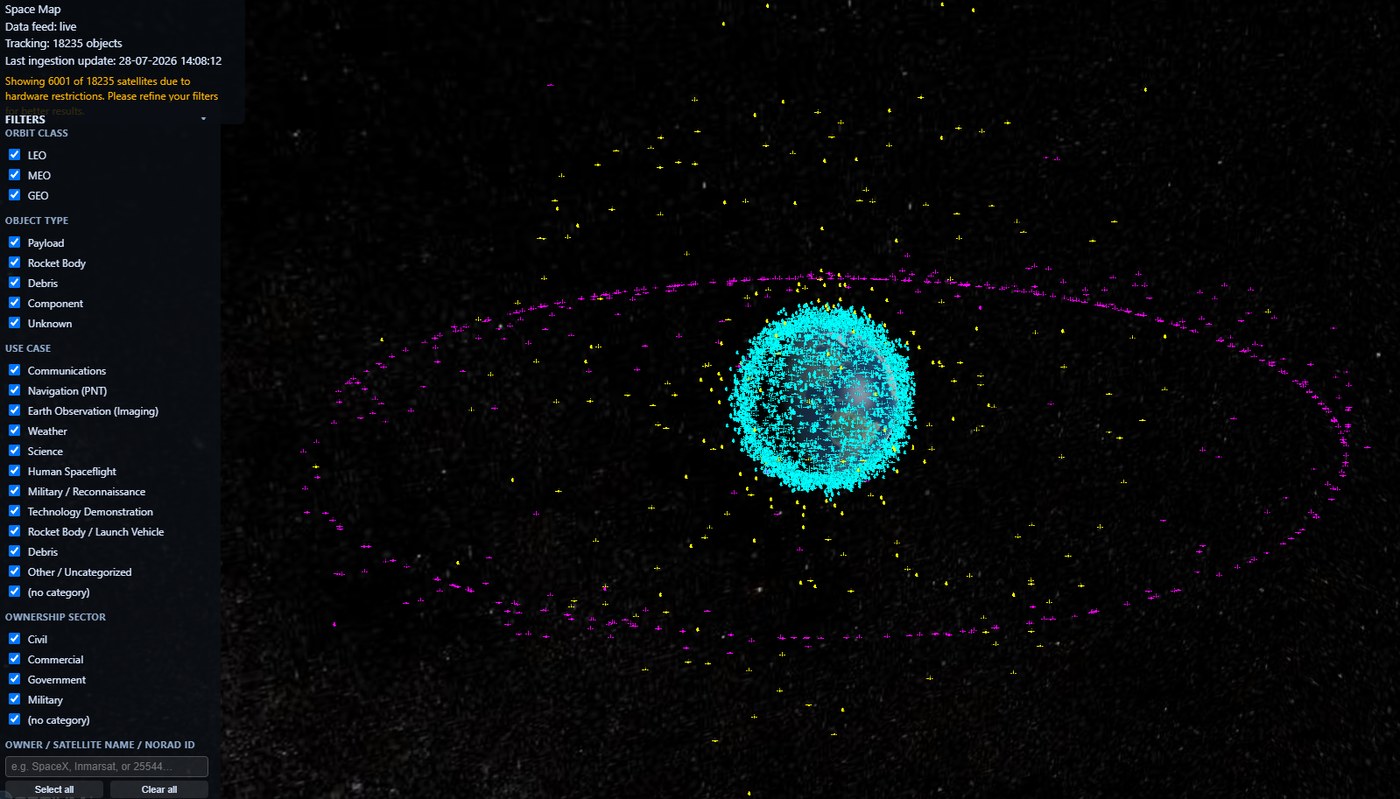
Concept: Telent’s Orbital Visualisation Tool was created to identify and demonstrate the scale of hardware and congestion within the Earth’s orbits. The demonstration tool has initially been built using open-source tools and data points and is entirely web-based at this point. It has been built using AI development tools and prompt engineering to shape the outcome, and is currently hosted on development hardware, browser-accessible, with rendered object count capped for stable performance. The tool can be demonstrated on request.

Continuing to pursue and grow Telent capabilities in Defence with a new focus on establishing and incorporating Space practices creates a sustainable, high-growth space market segment with strategic, multi-year revenue opportunities — aligning with Telent’s cloud, cybersecurity, AI, data, and digital transformation services. Telent aims to become the UK’s most trusted sovereign technology partner for Defence, Space and Critical National Infrastructure, delivering secure, resilient and integrated digital infrastructure, assured communications and satellite capabilities from Earth to orbit.

Live screenshot of Telent's Orbital Visualisation Tool tracking over 18,000 objects across LEO, MEO and GEO
Tracking 18,000+ catalogued objects — demonstrated on request.

The Telent tool has been designed to capture and exploit an amalgamation of the best elements of existing tools into a single bespoke tool, which can currently:

08 · Telent Organic Capability Growth (Data)

Data, Data, Data

In September 2024, recognising their importance, the UK Government designated data centres as Critical National Infrastructure (CNI). Data centres, data management, and secure, resilient networks and agile organisations are critical for hosting and delivering the IT infrastructure that underpins digital defence services, UK economic activity, public services and emerging technologies such as Artificial Intelligence (AI).

Future development in line with Telent’s position as a trusted partner and a leading UK technology company specialising in the design, build, support and management of the UK’s critical digital infrastructure aims to create a UK-based Space Data Hub Service, exploiting the proposed Telent Global Data Managed Network:

Single Data Ingest Point (SDIP)

Collate and amalgamate multiple sources to support multiple customers with the provision of ‘real-time’ or ‘near real-time’ data from existing suppliers and operational ISTARI, SDA and EO constellations through collaborative teaming and partnerships. Establish a catalogued service for management and processing of data, plus a bespoke charging mechanism for wider customer bases.

Data Management Service

A proposed concept of a centralised Telent Space Data Management capability, using a network of data collectors into the SDIP and a network of Data Centres and Data Sources to capture, store, analyse and distribute large amounts of data. Initial focus is on space data, but the overall concept can easily be utilised for any data source — e.g. Data Management within any customer ecosystem.

Data Network Infrastructure

Exploit Telent’s existing capacity to provide advanced Defence Network & IT services and pioneering Defence technology solutions.

Questions?

Telent — talent with technology. Let’s talk about how Telent can support the UK’s growth into Space & Defence.

Download Offline Copy

Telent Space Strategy

Mission-Critical, Mission-Ready Technology for the UK’s Next Frontier

Lee Harris · Solutions Architect · 5th August 2026

Vision: the UK’s most trusted sovereign technology partner for Defence, Space and Critical National Infrastructure.

£17–19bnUK space sector annual revenue
55,550people employed directly
18%of UK GDP relies on space services
£7.49return per £1 invested in ESA

The Opportunity

The UK space sector generates approximately £17–19bn in annual revenue, employing 55,550 people directly with a further 81,000 jobs in the supply chain. UK Government has committed £298bn in Defence investment over the next four years, with an estimated £3.2bn for space capabilities. MoD funding rises from £60bn (2024/25) to £74bn (2027/28), 27% higher in real terms by 2029/30 vs 2023/24. Space is now designated UK Critical National Infrastructure (SDR 2025).

Why Telent

Telent is a trusted partner and leading UK technology company specialising in the design, build, support and management of the UK’s critical digital infrastructure — well positioned to extend our integrated, collaborative capabilities into Space & Defence CNI. Space is a natural extension of markets Telent already serves: the long-term opportunity is to enable customers to securely operationalise satellite & space services at scale, achievable through strategic partnership & acquisitions.

Telent engineer working on network infrastructure
Telent engineers deliver and maintain the UK’s critical digital infrastructure.
Telent field engineer on site
Field-ready capability, deployable to support Defence & CNI programmes.

UK Space — Critical National Infrastructure

The UK Strategic Defence Review (SDR) 2025 confirmed space as UK Critical National Infrastructure and a domain central to warfighting — the war in Ukraine has triggered a strategic shift in UK Defence to treat space as a contested frontline, driving investment in sovereignty, resilience, and space control.

DARC

Global ground radar network enhancing Space Domain Awareness of deep-space and geospatial orbit objects, operated jointly with the USA and Australia; the UK element is planned for Pembrokeshire.

IASMDOC

A £40m initial investment integrating the command and control of air defence and space operations, protecting critical national assets.

SKYNET

A further £50m to extend SKYNET 5 military satcoms, replaced by new capabilities including SKYNET 6A, due in 2027.
1 / 2

Telent Capability Growth

Space Domain Awareness — Orbital Visualisation Tool

Telent’s Orbital Visualisation Tool identifies and demonstrates the scale of hardware and congestion within the Earth’s orbits — built using open-source tools and AI development tools/prompt engineering, entirely web-based. The tool can be demonstrated on request.

  • Displays space objects in LEO, MEO and GEO regardless of classification.
  • Click any object for its orbital flightpath and characterisation data.
  • Filterable by orbit class, object type, use case, ownership sector/owner, satellite name, and NORAD ID.
Screenshot of Telent's Orbital Visualisation Tool
Demonstrated on request

UKSA — Unlocking Space for Government

The UK Space Agency’s Unlocking Space for Government (USG) initiative enables public sector organisations to adopt satellite/space-enabled technologies — Earth Observation, SatCom, PNT — improving delivery, efficiency and resilience of public services. In summary, USG supports:

Central & Local Government departments seeking innovative space-related solutions to operational challenges.
Frontline Public Sector Organisations, such as NHS, Transport Agencies and Emergency Services.
Space Companies aiming to understand public sector needs and routes-to-market.
Policymakers looking to embed space in wider government strategies.

Proposed UK Space Data Hub Service

Single Data Ingest Point

Collate real-time/near real-time data from existing suppliers and operational ISTARI, SDA and EO constellations through collaborative partnerships, with a catalogued, chargeable service.

Data Management Service

Centralised Telent Space Data Management capability, capturing, storing, analysing and distributing data at scale — initial focus on space data, extensible to any customer ecosystem.

Data Network Infrastructure

Exploit Telent’s existing capacity for advanced Defence Network & IT services and pioneering Defence technology solutions.

Prepared for internal briefing; may also be used externally. Content sourced from the Telent Space Strategy presentation (05.08.2026).

2 / 2